
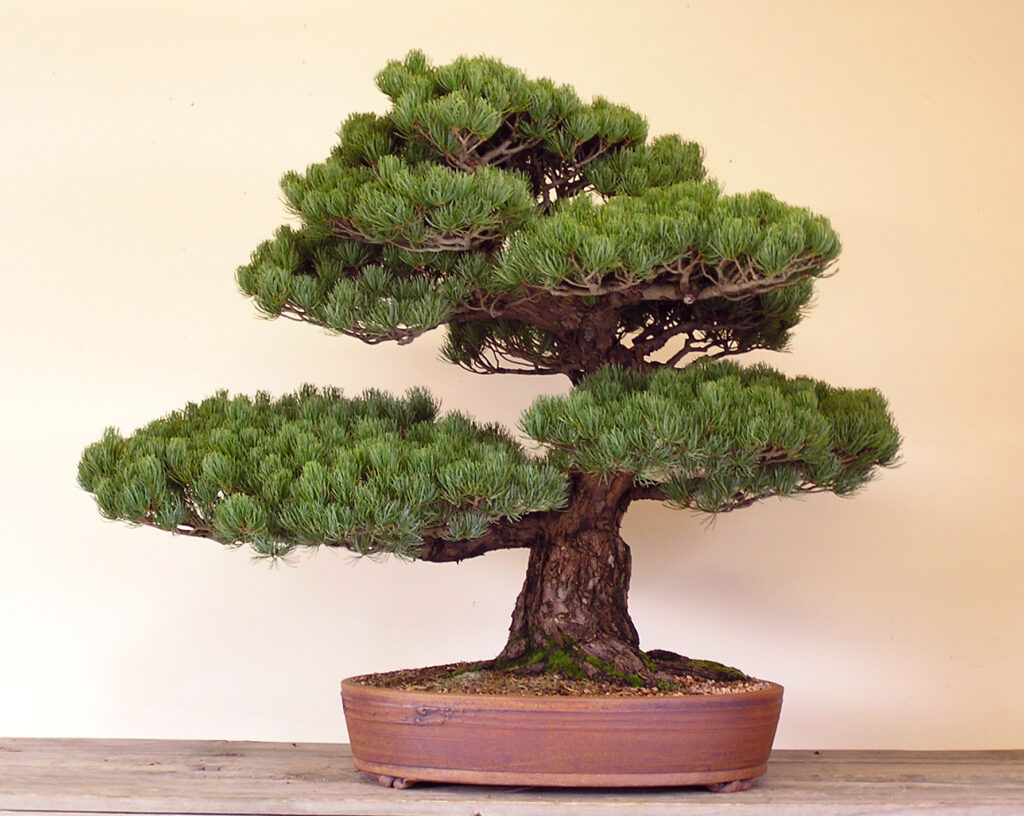
Common Name: JAPANESE WHITE PINE
Botanical Name: Pinus parviflora
Year Imported from Japan: about 1998
Estimated age when imported: 60 years
Initial styling by: Unknown Japanese artist
Donor: Howard Wright
Howard Wright was a longtime bonsai friend and client who liked small trees, but he liked big things even more. I’ve always said about Howard that he was one of these people who was impressed by ponderosity. At one time, he had “this thing” that he really wanted to get a big pine, a big white pine. And, he ended up talking with Frank Mihalic, who was importing some kinds of bonsai from Japan which was easier in that era than it is now. He told Frank what he was looking for. So Frank was making regular trips over to Japan to buy bonsai that he would bring back here to the States. .
What Frank did was to take pictures of several sizable white pines that were available in Japan and brought them back for Howard to choose from. And this pine was the one that Howard picked out from pictures and then it was brought back here by Frank Mihalic. But, one of the things that isn’t apparent to the casual passerby today is that this bonsai we have labeled Japanese white pine, is actually two different pine species grafted together to make them one tree.
The trunk is Japanese black pine, which is much more pot culture tolerant and less sensitive to grower oversight than Japanese white pine. The Japanese white pine is more refined looking having dramatically shorter needles . . . very attractive blue-green foliage. So if you look carefully at this tree, pretty much anyone can see where there is a transition in its trunk. The black pine trunk and surface roots have a really heavy, corky bark. And higher up the tree, the bark of the white pine is not nearly as rugged. That’s because two different pine species are growing here together as one tree.
And when Howard got to a point where moving and maintaining this bonsai was a bigger chore than he wanted to keep doing, he gave it to Hidden Lake Gardens.
The volunteers at Hidden Lake Gardens have a nickname for that tree. It’s “Sumo.” We call it Sumo, because it’s clearly the most massive tree that we have in our Collection. There are many bigger bonsai, particularly in the Orient, but we don’t have those. This is our big tree.
Learn how you can Sponsor this bonsai