
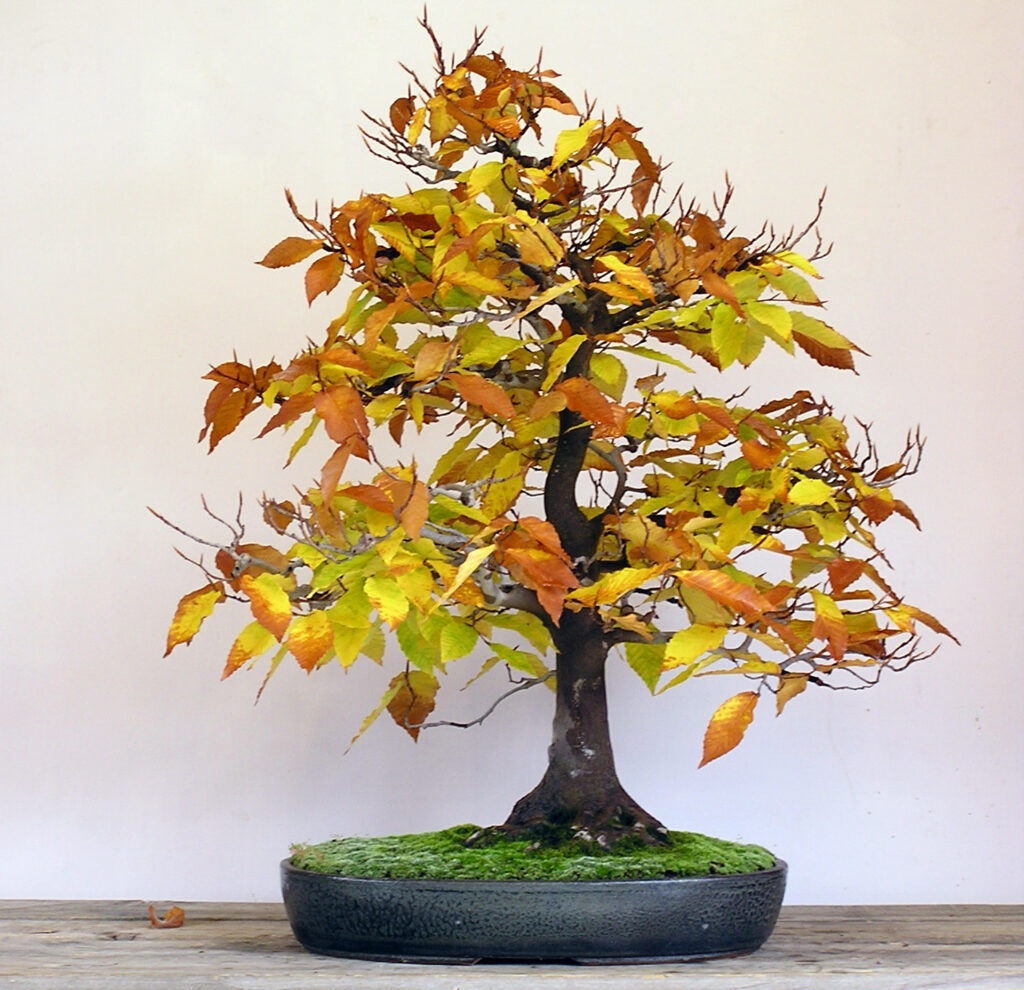
Common Name: AMERICAN BEECH
Botanical Name: Fagus grandifolia
Year first potted as a bonsai: 1967
Estimated age when first potted: 8 yrs.
Early styling by: Jack Wikle
Donor: Howard Wright
First disbudded in 1983 resulting in dramatic increase in ramification and number of active buds.
Of the bonsai that are out there at the gardens right now. This is the one that’s been grown longest in a bonsai pot without question. It was something I collected in a woodlot where I had permission to dig some trees back in the mid-1960’s. I was really excited about bonsai and trying to find anything I could get my hands on that might be useful as a bonsai candidate. In this woods, my memory is that there was just one beech tree, a smallish one, a lot of American hornbeams and some other things.
The hornbeams were what I collected mostly. But, this beech tree, as I remember, was maybe 6-7 feet tall, more than head high, and all of the dominant branches were shoulder high. Except that down low on the nice tapering trunk, there was a little, lateral branch that had grown out to the side and was trying to make its way upward from there. And as I looked at this beech tree with nice smooth bark and a nice firing base, I thought,”Wow.” This would be something to try, but it didn’t have any branches down low except for that one, really small one, little more than a twig.
And, as I thought about it, I realized, well, maybe I could just cut off the top of the tree; saw it off down to that branch and let that branch grow to be the new top. So that was what happened. You can look at that tree today and you can see where the trunk is quite straight for maybe 12 to 15 inches. Then there’s just a bit of a jog where the branches spread out to become the head of the tree. So that’s what happened. All of the top on this tree now has grown since the time it was collected. Of course, that’s more than 50 years now.
I have been looking at some notes I made in the late seventies and early eighties. This tree was often on exhibit in the lath house at Hidden Lake Gardens at that time. The bonsai on display there were my trees that I was taking care of on Hidden Lake Gardens time. And, this was one of them. And it was one of the most interesting of the trees I had.
So this beech was out there at the Gardens most of the time. But, a big issue for me was that this tree always grew pretty vigorously from the branch ends, and the branches were getting longer and longer, maybe too long, too rangy for the size of the trunk. So, I kept hoping for interior growth where I could cut back to a side branch to make the main branches shorter. And it just wasn’t happening. This was getting more and more extreme. I knew that bonsai people tell you aren’t supposed to be able to defoliate a beech. And, the botanists know that all the leaves are pre-formed in beech buds, and then the bud opens it just produces an enlargement of what was already there in the bud.
And if something happens to the new shoot, that’s its end. That is all that is going to happen that year. So, then you wait. And so I’d never really tried it. Anyway I’d heard repeatedly that you shouldn’t defoliate a beech tree. Okay, I’m not going to do that. But, I wondered what would happen if, before the tree spent a lot of energy in producing new shoots from very healthy buds, I just took off all the buds I could see, just cut them all off, disbudded the tree well before it started to grow.
Anyway, my thinking was, well, this is just getting out of hand. I don’t have many options. And so I tried disbudding. And, interestingly, soon there were buds I hadn’t been aware of before, buds that had never been active which showed up back inside the tree and began to grow. This disbudding technique worked so well that over next few years I was disbudding almost every year. And my sense was that in a few years I had maybe 10 or 20 times the number of actively extending branch ends. This tree was far more twiggy than it had ever been before.
So it worked very well. An interesting thing was that I’d discovered a technique that seemed to work pretty well with my beech tree. Now, I’m really curious. Are they doing this in Japan? And so, over the next few years, I talked with Cathy Shaner and some other people who had been apprentices in Japan, and I asked them if they ever disbudded beech or other bonsai as an apprentice, and their response was uniformly, I’ve never heard of that. Why would anybody do that? And to take that story little farther, it was some years later, 1993, that I had the opportunity to spend some time with Stanley Chinn, a bonsai grower and a bonsai teacher (mainly in the Chinese community) who lived in the Washington, DC area. As a young man, Stanley had worked a number of years for uncles who were professional bonsai growers in China. My understanding is that he escaped from China during the Cultural Revolution and eventually made his way to the United States.
So he was very knowledgeable in a Chinese way about bonsai. And I had a chance to talk with him and ask him some questions. Of course I asked him, do you ever just take off all the buds? “Yes, sure. We call that calling up buds.” So there was a cultural thing there. The Japanese weren’t doing it but the Chinese were.
One factor here may be, when I tried it on a Japanese beech, it didn’t work nearly as well as it did on the American beech. This experience with my beech led me to disbudding a variety of other things, particularly elms and hornbeams, things that I wanted to be more twiggy. Just take off all the buds before they begin growing, and you get a really pronounced response. A lot of stuff happens back more in the interior of the tree, that wouldn’t if you didn’t do that.
This beech is the tree at Hidden Light Gardens right now with the longest history of cultivation as a bonsai.
Learn how you can Sponsor this bonsai.